


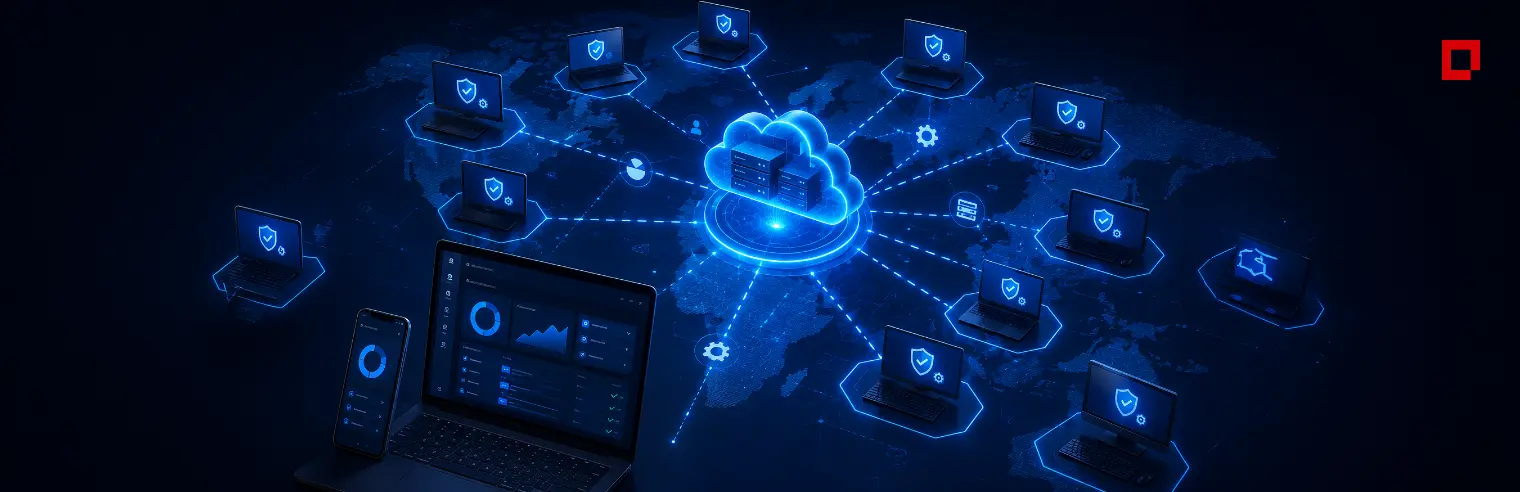
Organizations now run hundreds or thousands of endpoints spread across distributed locations. Visiting each machine to configure it, repair it or check its state is no longer practical. Managing endpoints at scale means doing all of this remotely, from a single console.
This article covers the key challenges of managing endpoints at scale and how centralized cloud management addresses them.
Challenges of Managing Endpoints at Scale
As the number of endpoints grows, problems that are trivial on one machine become serious across a fleet. Three challenges stand out when devices must be managed without hands-on access.
Configuration Drift
Every endpoint starts from a known configuration, but that state rarely holds. Users change settings, install applications and updates land unevenly, so each machine gradually diverges from its baseline. This is configuration drift.
Across hundreds of devices, no two machines are configured identically. This makes behavior unpredictable and support inconsistent. Security gaps become harder to catch, too. Without a central record of how each device should be configured, drift accumulates quietly until something breaks.
Manual Remediation Burden
When a setting needs to change or a fault needs fixing, doing it by hand means addressing each machine individually. For a few devices, this is manageable. But across a large fleet, it consumes enormous time, and repetitive work invites mistakes that create fresh inconsistencies.
When machines are spread across sites, remediation may also require travel or scheduling around users, adding delay. The team ends up repeating corrections rather than resolving them once at the source.
Limited Real-Time Visibility
To manage endpoints effectively, an administrator needs to know their current state, yet that is difficult to determine without a central vantage point. Reactive monitoring methods (periodic inventories, user reports and manual checks) always leave the picture somewhat out of date.
A device that has fallen out of compliance or developed a fault goes unnoticed until it causes a visible problem. Across a large, distributed fleet, these blind spots multiply and decisions rest on stale information rather than current fact.
Centralized Cloud Management: Enabling Remote Endpoint Configuration
Centralized cloud management answers these challenges by moving control off the individual device into a single console reached over the internet. Administrators configure, fix, and monitor every endpoint from one place.
Automated Configuration Deployment
Instead of configuring machines one by one, an administrator defines a policy once, and the system applies it automatically to every assigned device. New machines receive the correct configuration the moment they enroll, and later changes reach all of them without anyone touching each device.
Grouping by role or location lets different configurations apply where they belong. Because the intended state is defined and enforced centrally, every machine in a group is set up identically, directly countering drift.
Remote Remediation
When a device needs attention, the fix happens from the console rather than at the desk. An administrator can push a corrective setting, send a command, or remote in to investigate. No physical presence required.
A single action can reach many devices at once, so a fault affecting a whole group is resolved in one step rather than machine by machine. This removes the travel and scheduling that slow hands-on repair and corrects problems as soon as they are seen.
Real-time Endpoint Monitoring
A central console continuously reports the current state of every connected device. Administrators can see configuration, update status and health across the whole fleet at a glance.
Alerts surface a problem the moment it appears rather than when a user reports it, and a drifting device becomes visible at once. This live picture makes management proactive rather than reactive, because decisions rest on what is true now, not on inventory that’s several weeks old.
Discover Faronics Cloud
Faronics Cloud applies these principles in a single web-based console for your Windows and Mac endpoints. Configure, remediate and monitor every device remotely, with no on-site server to maintain and no per-machine visits.
FAQs
Can Endpoints Be Configured Remotely Without a VPN?
Yes. A small agent on each device connects outward to the management service over standard web protocols. Because the device initiates the connection, no VPN or inbound firewall rules are required.
How Does Centralized Endpoint Management Scale Across Multiple Sites?
Because management runs over the internet rather than a local network, location does not matter. Endpoints at every site report to one console, where administrators apply site-specific policies by grouping them. Adding a site means enrolling its devices
How is Configuration Drift Prevented Across Distributed Endpoints?
The intended configuration is defined centrally and enforced automatically. Each device is checked against its assigned policy, and when one deviates, the next refresh brings it back into line. Because enforcement is continuous and central, configurations remain consistent.





 your Deep Freeze license count and free for up to 3 years